
Do I Even Exist?
A book review of "Depending on No-Thing" by Robert Salzman, the audio version, and some of the places it made my mind go.

This article is long. TLDR;?
If you don’t have time to read the long article that follows, I conclude with a very brief but informative summary.
How the book ended up in my hands. Uh, ears.
Soon after I joined Substack a little over a year ago, I encountered articles by Robert Salzman. I always found them intriguing. Given the books on Buddhism I’d been reading for years, and my own perennial questioning of what I really know for sure (if anything), Robert seemed to be saying things I was a bit familiar with. That we do not have intrinsic, unchanging selves. That everything is interdependent. That all we can be sure of is the flow of experiences that stream past or through our awareness. His writing possessed a stark clarity and elegance that made it stand out from much of what I read (or wrote) on Substack.
Soon after I started reading Robert, I began commenting on his articles in addition to just “liking” them. In some of my comments, I tried to rephrase in my own words aspects of what I thought Robert was saying in his article, and then I’d hazard a question about it. Almost never, if memory serves, did Robert agree that my rephrasing reflected accurately and completely what he was expressing. Except for one time, he always corrected my interpretations. So here’s a warning: bear that in mind later in this article when I tell you what I think Robert is saying in his most recent book.
It’s curious. Robert writes very clearly and lays out his ideas so simply, yet readers who pose questions struggle so hard to put in their own words what they think he’s saying. It’s not because of how or what he writes, I’m convinced. It’s because we’ve all been trained to look at reality in way more complex, convoluted ways than Robert does, piling one metaphysical assumption upon another. And we have so much trouble letting go of all that, even just for a brief time as we try to wrap our heads around his spare and stark ideas.
Recently, a post of Robert’s offered a free audio version of one of his two most recently published books — The Ten Thousand Things (often called 4T for obvious reasons) or, published one day later, Depending on No-Thing (which I’m going to call DoNT in this article for equally obvious reasons) — to readers who would agree to review it on Amazon, Goodreads, etc. He said to email David Matt in order to claim the offer. David, it turns out, is the narrator for the audio version of DoNT (Robert narrates 4T).
Well, free copies of books, especially audio books — that’s music to my ears! So I emailed David posthaste and said I was interested. David seemed to want me to choose DoNT instead of 4T, I assumed because it’s longer and more people would prefer to review a shorter book. I love long audiobooks, so soon I had a copy of DoNT in my hands. Or resounding in my ears, I guess I should say.
My overall impressions
The book is a joy to listen to. It took me just five minutes to get comfortable with David Matt’s soothing reading style and voice. Such a calmness would descend on me as I listened. Part of it was Robert’s language and the concepts, but part was David’s melodious narration. I listen to audiobooks when I walk to the store or do yardwork. Bouts of mowing, which I have to do a lot of since Blake and I have a biggish yard and I use a human powered push mower (no fumes and minimal noise), present perfect opportunities for me to indulge in audiobook listening. Likewise when I plant stuff in the garden or weed the beds.
DoNT is a big book. The Kindle version and paperback are about 640 pages long. The audio version is a little over 23 hours. I really enjoyed those 23 hours over the next few days. I felt like Robert was talking directly to me using Matt’s lyrical voice.
A lot of the book, maybe all of it, consists of dialogues between Robert and readers, a big long series of questions and answers. You might think this is a bad way to create a readable (or listenable) book. But no. The back and forth, if anything, creates interest, and Robert has carefully organized the dialogues into a bunch of different topic areas. I listened to each chapter, to the whole book, with delight. And I learned a lot about Robert’s ideas and views. Things I had never quite grasped while reading his Substack articles. Robert truly did make his unique ideas clear in DoNT.
Robert in a tiny nutshell
Two quotes from Robert’s writing will give you a quick foretaste of where he’s coming from and will make what follows easier to grasp. They are both from his Substack article What’s Wrong With Nonduality? First:
[N]o one knows what any of this is. That is not a concession. It is the most accurate thing that can be said. The universe is here. Life is here. Consciousness is here. What any of it ultimately is remains beyond what any instrument available to us can establish.
And:
What clarity looks like, as I have come to understand this, is not the dissolution of the self into a boundless ocean of consciousness. It is not conjecture about the substrate of reality. It is not certainty or truth, but something simpler: a recognition of the limits of human knowledge without needing to reach past those limits, and in that recognition, finding sufficiency and relaxation.
What I took away from DoNT
As I said above, what follows is how I understand Robert’s ideas. I’m not sure he would sign off 100% on any of it. Or even 75%. Although…I did have a little back and forth with him the other day in the comments section of a recent article of his, and after I tried several times to describe something I experienced that I thought mirrored things he reports, he actually said I got it right. He then proceeded to rephrase what I said in vastly more concise and elegant language. So maybe what I am about to say won’t be too far off the mark, though read Robert’s own material to guarantee accuracy and elegant wordcrafting.
Here are the basic ideas Robert returns to again and again, both in his articles on Substack and in DoNT.
Each of us has no intrinsic, unchanging self. No essence that remains constant during life, and certainly not one that continues after death (when the stream of experience runs dry).
Life is a beautiful gift but it includes a lot of hard stuff (as well as a lot of fun, joy, and love). It approaches its end in suffering and decline, and terminates in death, and all of this should be faced squarely and courageously— experienced fully and head on — without trying to draw comfort through flights into religious or metaphysical fantasies.
There is no distinction between an experiencer and experiences. We are just the stream of our experiences. There is no inner homunculus or Brahman split-off who is the true self registering or receiving experiences. The flow of experience is all there is to our lives. We are not one with any other stream nor with all that is nor with some transcendent reality.
I believe that Robert claims making metaphysical assumptions is unwarranted. Using induction, deduction, and/or inference to generate overarching theories of reality beyond and based on our flow of experiences is not justified or worth spending time indulging in. All it can yield are unverifiable theories of fantastical realities.
Despite the above assertion, best I can tell Robert does subscribe to physicalism or materialism. He accepts the theory of evolution by natural selection. Before I listened to DoNT, I thought he was absolutely against any metaphysical speculation and hence would not say he actually believes in any theory of modern science. I’ll discuss this more below, but it seems clear to me that believing in materialism / physicalism requires some metaphysical speculation. Robert might disagree. But in DoNT he comes right out and says he accepts the theory of evolution, and he strongly implies that he also accepts the theories of modern physics, chemistry, and biology. And given his background as a therapist, I’m guessing he thinks at least some validity lies in modem theories of psychology.
Let me approach what I just wrote from a slightly different angle. I think Robert would say we do have a body and a brain very like what our experiences suggest. We can trust that the objects of our experiences fairly closely represent what really exists. We can trust that most of what scientists tell us is true, and we can definitely trust the neo-Darwinian view of how evolution happens. Also, to a fair degree, the findings of the psychological sciences. We are justified in assuming and relying on naturalism or physicalism, but to go beyond that requires too much unjustified metaphysical speculation.
It may also be that what I said in the previous two previous paragraphs does not quite capture Robert’s view. Instead, he may not assume that physicalism / materialism and evolution and physics and psychological theories are true, as this would entail subscribing to at least a small number of metaphysical beliefs, but that his stream of experiences includes a sense that proceeding as if they are true leads to a further set of experiences that he enjoys having and that let him feel as if he is acting rationally, which he apparently finds gratifying. Even this is probably at least a bit off the mark.
So finally, try this: Robert’s stream of experiences contains a feeling that materialism / physicalism and the claims of modern science are reasonably reliable and at least roughly conform to what is really out there, if anything is.
It’s surprising how often Robert brings up and disparages Advaita Vedanta, one of the most prominent philosophical schools within Hinduism. Its key concepts include Brahman (transcendent, ultimate reality), atman (essential self, one with Brahman), maya (illusory physical reality, feelings of being separate from Brahman), and moksha (ultimate liberation from maya and rebirth). Apparently Vedantists are attracted to Robert’s writings in far greater numbers than, say Christians. Or maybe Robert just has more trouble with the ideas of Vedanta than he does with Christianity. Robert brings up Buddhism a lot too, but seems to agree with some of its basic notions like emptiness, anatta (no essential self), and dependent arising (or codependent origination). And reincarnation? No way in hell! He had some close brushes with Buddhism in his younger days. He says he’s not a Buddhist now, but that Buddhism comes closer than other spiritual paths to getting things right. Except not reincarnation!
Robert loves photography and discusses it often. He takes lots of striking photographs and has for decades. The person who apprenticed him in photography was a huge influence on his life. While Robert’s pictures, the ones I’ve seen anyway, are stark, very like his writing, they are, again like his writing, elegant and artistic and evocative. They powerfully reveal (to me, anyway) that experience contains beauty and suffering. 4T features a lot of his images (so get the print or Kindle editions) but DoNT doesn’t so the audio version is perfect if you enjoy ingesting your reading material through your ears.
Free will does not exist. Generally we “decide” to do things by following our attractions and desires and avoiding our fears and aversions. We don’t choose our desires, attractions, aversions, and fears, we discover them within our experiences, and they are there because of (theory alert!) our genes and upbringing, neither of which we had any meaningful control over. Even if we step back from our desires and fears and try to “make” decisions based on reasoning, we can’t actually catch ourselves doing the deciding. We find that decisions just appear in our experience stream. When Robert talks about free will, it gets my hackles up because I badly want to believe we have free will. So I “made” a decision to try to observe myself in the throes of the decision-making process, to catch myself doing it by attending carefully. I write about the results of those experiments below. Spoiler alert: I’m no longer sure what it even means to actually make a decision.
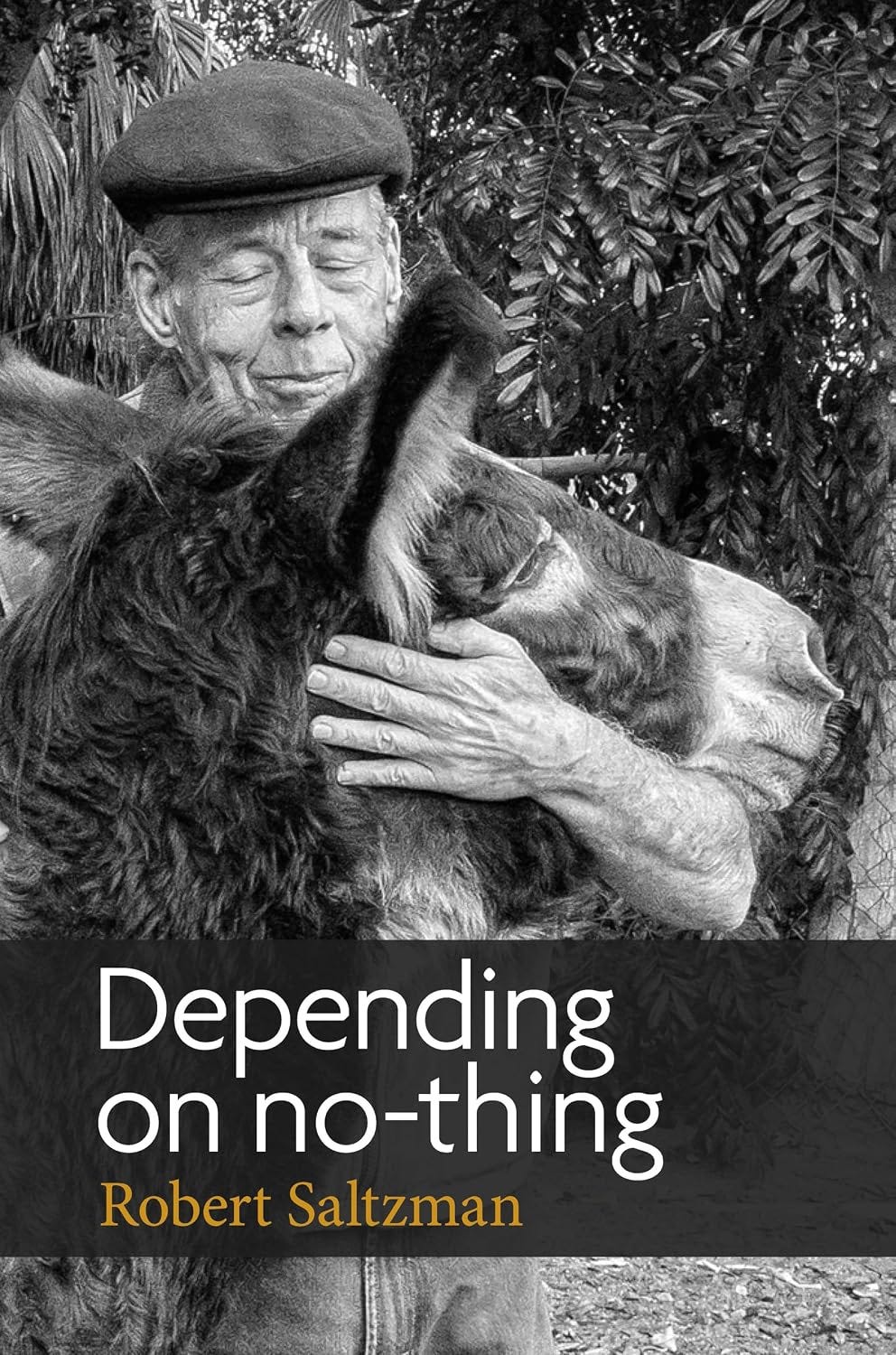
One thing I particularly love about Robert, because I am the same (so he must be right!), is that he has a soft spot for animals. His experience stream includes impressions that animals suffer a great deal at the hands of humans due to human exploitation. He feels that this is cruel and unnecessary because there is so much to eat that doesn’t involve torturing and killing animals. The cover of DoNT shows Robert blissed out while hugging one of his donkey companions. I can’t look at that picture without loving Robert. And, of course, the donkey.
Robert calls himself “awakened” any number of times in his Substack articles and throughout DoNT. At first, that term made me squirm. How could anyone actually claim to be awakened? But gradually I came to see what he meant, and it was way less grandiose than I’d first thought. In a recent article, Robert describes it very succinctly and clearly. Awake “means a grasp of the human condition that includes a recognition of epistemic limitation. I mean a borderline beyond which we know nothing definite or even nothing at all.” Given this meaning, I am tempted to claim I am awakened too. I’ll explain that in more detail below.
Robert emphasizes again and again, but it’s so hard to keep in mind as he assails so many of your cherished beliefs and illusions, that he is describing only his experiences and his understanding of those experiences. Here’s a quote from one of his recent Substack articles: “I describe what I observe as clearly as I can and leave it there. If someone learns from that, fine, but I am not transmitting a body of knowledge, only clarifying my own view. My words reflect my experience, nothing more.” He is not telling you what you should think or how you should understand your experiences. But he is very uncompromising about anyone else trying to put their interpretations on what he experiences. Many of his readers can’t resist doing that, as if to show Robert where he goes wrong. I have fallen prey to that myself.
Why do readers want to do this when all he is describing is what he goes through and how he understands it? I guess it’s because he writes so clearly that it’s almost impossible to read him and not feel seriously challenged, as if he’s dismantling your cherished views of reality right before your very eyes.
Yet Robert can be amusing and endearing at times. While he is firm that his experience stream does not contain metaphysical speculation, he tells readers that if they enjoy indulging in such pastimes, then they should “Go for it! More power to you! Mazel tov!” These words, repeated a number of times in DoNT, and read with a humorous twang by David Matt, tickled me every time I heard them.
In this section I have tried to express in my words what I think Robert is saying. A couple of days after I originally posted this article, Robert posted an article that responded to some of what I said here. He explained himself with beautiful clarity in that article, so please give it a read if you want Robert’s key ideas in his wonderful words:

Am I awake?
So that’s my formal book review. Now I want to reflect on some of the things Robert talks about in his writing. Let’s start with awakening.
Once I grasped what Robert means by “awake” — why that took me so long I don’t know — I have to wonder if he would consider me awake. It’s been decades since I first started wrestling with the idea that I don’t really know much of anything. People around me have always seemed so certain. The people I met in churches seemed especially prone to this. But it quickly became evident in political discussions as well, on the left and the right. Everyone I knew seemed to think they know things for sure. The only thing I was sure of was that I don’t.
One area where this really became clear to me was in discussions and articles about abortion. On the one side there are people like my friend Mary Alice. She was once a student of mine when I taught chemistry, physics, and math at a Catholic girls high school on the South Side of Chicago in the late 1970s. We have remained friends in the years since, and I dearly love her. She and I saw politically eye to eye back then, but as the years have passed, she’s become more and more conservative politically and religiously while I continued to lean left and bounce all over the place spiritually. Her big issue is abortion. She is anti, of course. When we discuss it, she is very firm with me. “I know abortion is wrong,” she’ll say. “I know God creates a soul at the moment of conception.” I can’t help asking, “How could you know something like that? You believe it, yes I get that. But knowledge?” She tells me that she “knows it” in her “heart with a certainty that rivals knowing I exist.”
Well I certainly don’t know anything about the existence of souls. I can see that they might exist. And they might get created at bodily conception. But that’s as far as I can go with souls. Then there are my liberal friends. They are absolutely sure that just-conceived zygotes do not have souls and it’s perfectly fine to terminate them. I don’t see how they could know that. How do they know?
When I use my reasoning to probe the issue, here’s the best I can come up with. I don’t know if anyone has a soul. Even if there is a spiritual reality, it isn’t clear that it’s dualistic in the sense that physical reality exists and separately from that, spiritual reality exists, and God gives physical bodies spiritual souls at conception, or perhaps at birth, or perhaps somewhere between, or perhaps even at some time after birth. How would we know such a thing? What if reality is panpsychic? Consciousness built into every physical entity, even quarks? Or what if the physical is all that is and consciousness is simply the stuff of neurological processing? Science is a long way from explaining how that would work, but it still might be the case.
Even if God told me that souls exist and that just-fertilized eggs have them, or told me that souls do not exist and it’s not wrong to terminate early fetuses, how would I know that it’s really God telling me such things? Say there were deep feelings of transcendence and otherworldly joy accompanying God’s words. Should that convince me God is talking versus that it’s a hallucination or Satan is attempting to fool me? I would probably find such an encounter convincing, and I might come away believing what I was told, but it still wouldn’t be knowledge. It would be belief.
Given what science says, it takes a certain degree of neurological development before an organism with neurons can feel things including pain, or care about things including whether it lives or dies. So if you terminate a fetus before it has enough neurological development to feel and care, how could that be wrong? You cause no suffering to that fetus. It could care less what happens to it. Now I’m not saying that that’s a 100% right way to look at it. How would I know? I don’t know. In the end, I don’t know whether abortion is right or wrong, and if it’s okay at an early stage of fetal development but not later on, or if it’s always okay right up to the moment of birth. And I simply don’t see how anyone can claim to know either the whether or the when. Why aren’t we all saying we simply don’t know? We believe this or that. We feel strongly about this or that. But do we know? We do not!
So I have thought about not just the abortion question but every issue in my life, and what it all comes down to, and I’ve felt this for decades, is that I just don’t know much of anything. In fact, I know only one thing, and that is what I experience. I remember what I have experienced in the past, except I don’t know if my memories are accurate. So I’m really not sure if what I remember of my past really happened. I think most of it did. I feel that most of it did. I believe something roughly like it did. But I’m not sure, especially the farther back I cast my remembering. And then there’s ideas like this: say I and reality were just created five minutes ago, and I was given a set of memories that seemed to me to span a lot of the distance back to my supposed birth which I remember being told was 74 years ago. And yet all but five minutes of those memories are false. I don’t believe that is what happened. But do I know that for absolute sure? Of course I don’t. I can’t know something like that because what happened five minutes ago is not something I am experiencing now.
So yes, I do know what I’m experiencing right now. But right away that fades and I experience something else. So I know that I exist and I know what I’m feeling and thinking now. But I don’t know if any of the ways I interpret what I’m experiencing reflect some true reality. For example, it appears to me that I have a physical body which exists in a physical room in a physical house in a physical yard in a physical city in a physical country in a…well, you get the picture. I think that conception at least somewhat closely conforms to reality. I believe that it does. But in a few hours I will be lying on my bed having a dream in which I perceive myself embedded in a reality that does not exist. Yet it will seem very real to me…until I wake up and perceive where I really am. Unless I have a hallucination like my college friend Johnny Clayborn did in which, upon waking from sleep, God told him to go take possession of a just-built condo unit. What happened next was Johnny went there and started squatting, but soon found himself taking possession of a jail cell for a few hours and then a psych ward.
So I reckon that I hardly know anything. I believe stuff. I have a robust conception or interpretation or model of a reality I feel physically embedded in. But I’m not absolutely, 100% sure it really exists at all (it could be a VR simulation that God has made so vivid and convincing that there is no way for me to detect that it’s just in my mind) and I’m pretty sure (read: believe strongly) that it reflects something real to a degree but is missing a lot of information. E.g. I perceive only the miniscule part of the electromagnetic spectrum that human eyes can see. What would reality look like if I could see all those amazing additional frequencies? What if I could perceive dark matter? What would my conception of the reality I’m embedded in be like then?
Truth be told, I could go all the way to solipsism if I let myself. Not a convinced solipsism, of course — how would I know? — just as a possibility that I can’t totally rule out.
So would Robert Salzman reckon me awake? My sense of reality and my conception of it definitely include “a recognition of epistemic limitation” which he says is the hallmark of awakeness. Do I feel I’m awake? What I feel is I’m profoundly ignorant. But no more or less so than you, dear reader. Or than Robert Salzman. We are all just wandering about groping for the truth as best we can. Whether we’re awake or sleepwalking.
Do I choose to believe in free will?
One thing Robert says a number of times in DoNT and in his Substack articles (and no doubt in 4T as well) is that we do not have free will (or at least he doesn’t). We have no control over what flows into and through our awareness, and there is nothing to us beyond that flow as far as we can know. In a few places, Robert even suggests to readers that they try to observe themselves actually making a decision.
He issued that as a challenge and I decided to accept it. Here’s what I found.
First let me note that I am not an unbiased observer. I want free will to exist. I have a soft spot for open and relational theology (ORT), and one of its key ideas is that experience and agency exist not just in us but all the way down, in some form, to the organs and cells and molecules and atoms and subatomic particles of which modern science says we are composed. This is called panexperientialism by many in ORT. Philip Goff calls something like it pan-agentialism in his book Why? though mostly he just uses the word panpsychism in his Substack articles. Tom Oord and many others call it dual-aspect monism. And because all levels of reality have at least some ability to choose, all of reality participates with God in co-creating what reality is becoming. I find this notion beautiful and want it to be true.
So with that conflict of interest disclosure out of the way, let me describe my experiments. First, I looked at what happens when I feel a desire to do something and then do it. I notice a desire, say, to eat a banana (I am very fond of bananas). When I notice the desire, it is too late to try to see where it came from. So I do a reset by distracting myself and start being very attentive to my experience flow. Sure enough, that desire for a banana resurfaces. And this time I do notice where it came from. It came out of nowhere! I didn’t decide to feel that desire. It just emerged into my awareness from who knows where. My subconscious mind, maybe? My hungry physical body? I have no idea. One second it isn’t there (or I’m not aware of it) and the next second it is. I’m aware of it being there but I have no idea from whence it sprang. So clearly, I do not choose my desires. Or decide to have them. I’ve tried this many times since and I can say for sure that I do not choose my desires. I can choose to suppress them, it seems. And I can try to summon them forth from wherever they spring by imagining them or reminding myself of them or turning my head and noticing, say, a bunch of bananas. I can invite them, in other words. But I don’t seem to create them. Not consciously.
So I feel a desire and act on it by eating a banana. If I do this in my experiment, I am still paying attention, so it’s clear to me that the decision to reach up to the top of the fridge where I keep the bananas (a lot of them!), just like the desire itself, simply enters my awareness without my consciously doing anything. I feel the desire (not by explicit choice), then I find myself reaching for a banana (again, not by explicit choice).
If you think I’m wrong here and that you can make desires appear, then try this experiment. Think of something you like to eat really well. Let’s say it’s pancakes smothered in maple syrup. Rustle up a giant stack of pancakes and get out your jar of maple syrup. Put 40 pancakes on a big plate and slather on the maple syrup. Sit down and eat every one of those pancakes and slurp up every drop of syrup until you wonder if you’re ready to vomit. Now make that desire for pancakes surface in your consciousness.
How did that work out for you?
It occurs to me that acting on my desires, going with the flow, is not that good a test of whether I can actually make decisions or not. Likewise, avoiding actions because I am scared of what might happen if I do them, or because I feel disgust around whatever the action is (e.g. my foot is about to squish into a festering pile of dog poop), is not a very good test either. So maybe going along with my emotions, doing what they prompt me to do, does not involve free will. The feelings just appear on their own and my unconsidered actions just happen on their own. That process does not require active choosing.
So what would a better test be? What about when I have to weigh competing emotions against each other in order to resolve indecision? That seems like a case where at least some free will might be involved. So how do I put that to a test in an experiment?
I used to be a heavy drinker. Then I started realizing that heavy drinking over a number of years was likely to lead to problems. Physical, emotional, and, assuming such a thing exists, spiritual. I decided I had to cut down on booze or give it up altogether. But I had such strong desires to drink every evening! How could I just ignore those desires? I tried a few times and failed, especially if I just tried to drink less. One sip was all it took, generally, to dissolve my resolve. Then finally, by not taking that first sip, and then being very disciplined, even rigid, I succeeded (till now anyway). At first I had to grit my teeth every evening and force myself to stick to the plan. Days passed during which it got easier and easier. I discovered fake (non-alcoholic) rum. Pretty tasty when mixed with a stevia-sweetened cola-like soda pop. I now have a fake mixed drink every evening. No buzz, but also no memory blackouts or morning-after hangovers. I think I’ll be able to maintain this pattern of abstention until death (or near death — more on that in just a minute). In fact, I’m pretty sure I will be able to since it’s become a habit. It feels absolutely natural now not to drink. There’s no temptation, not even on social occasions when others are drinking all around me. I just nurse a fake cocktail or some n/a beer.
I mentioned near death. What’s that about? Well, if I got a terminal cancer diagnosis and my doctors said I had a few months or a year to live but that nothing short of a miracle would keep me alive after that, and if I fight it, it will require lots of unpleasant chemo or radiation or multiple surgeries, well, I think I wouldn’t fight it. Instead, I’d welcome real rum back into my life. Every night. Maybe even starting in the late afternoons. Enough to get blasted. And just the thought of that sends a quiver of almost forgotten desire up my spine. So clearly, my attraction to alcohol is not gone but buried somewhere. Held down and locked in a dark, dank prison cell somewhere.
But when I think back to fighting my desire during the first days of the struggle to abstain, I have to probe my memories. And my memories are not detailed enough to reveal if I explicitly made conscious decisions. But isn’t it obvious I had to make a decision, multiple decisions really, in order to get to where I am today, the desire for alcohol well buried? It seems like it. But…
But then I realize: I was able to succeed because of desire. There was one desire. I wanted to drink. But there was another. I didn’t want to suffer the consequences of long term heavy drinking later in old age. I want a robust old age, bursting with health and vitality and mental alertness. So in those early days, when the desire to drink would seize me, I had to make myself think of my other desire, to enjoy long term health. I had to grit my teeth and use my will power hour after hour, minute after minute, on a number of successive evenings until the habit of not drinking wrestled its way into existence and became durable enough that I could relax my will power.
The trouble is, I’ve had to consult faded memories, or even possibly edited memories, to come up with that little story. How could I do something similar now so I could watch it actually happen in real time, in the midst of the flow of my experiences, so I could see what the process of choosing one desire over another feels like?
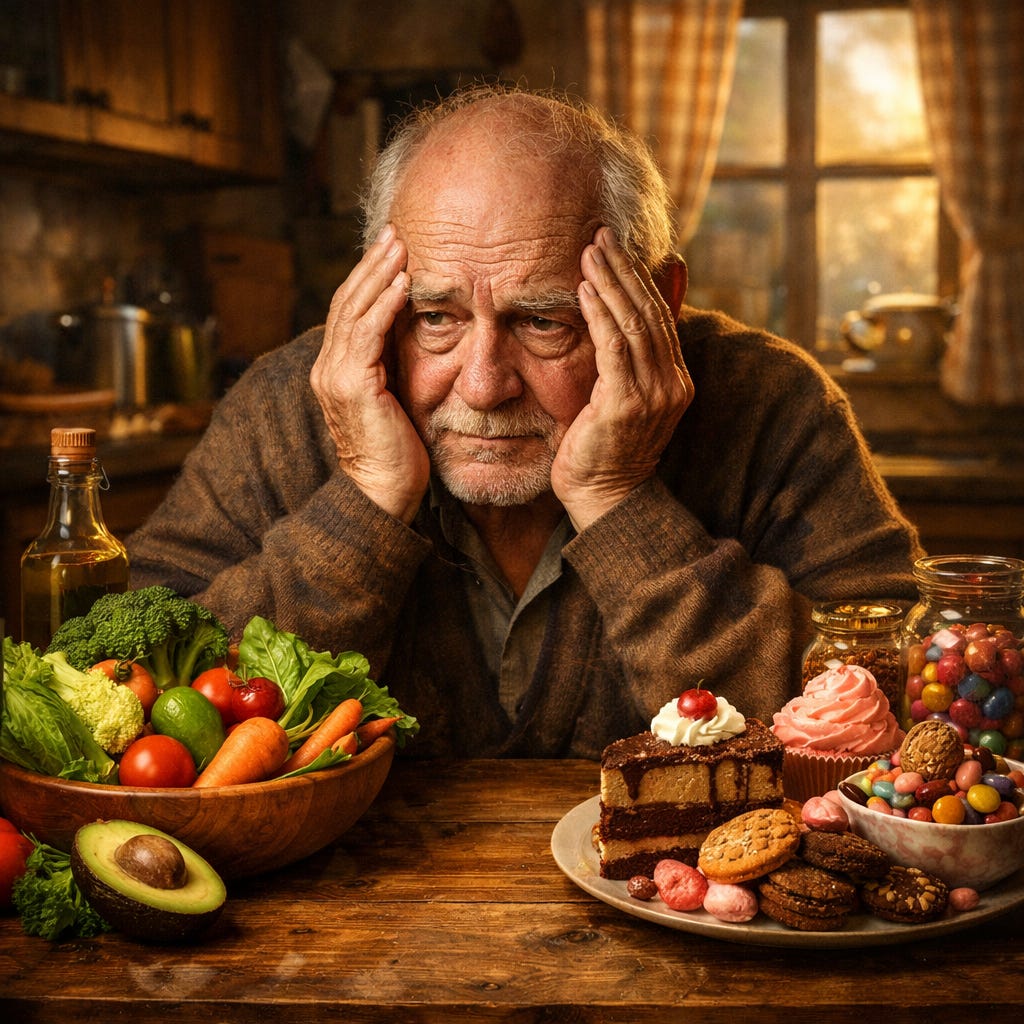
Well, I have an analogous (though less dire) problem these days. I live with my partner of 40 years, Blake. He and I eat very differently. I aim for long term health. Plus, as I said above, I have a soft spot for animals and don’t want them tortured and killed to put food on my plate. So I eat a no-salt, lowish fat, whole foods vegan diet. Or try my best to. The problem comes in because Blake’s eating goals and habits are so different from mine. He eats strictly for pleasure and loves meat and dairy and ultraprocessed foods with lots of salt and fat. And he buys plenty of snack foods to have on hand at all times. So our pantry has delicious crackers and chips and cookies and candies and our freezer has ice cream and popsicles. He makes delicious fried corn bread (high in sodium and fat). And he loves to bread and fry yellow squash in what seems like a gallon of oil and half a cup of salt. And…you get the picture. On top of that, he longs for other people to enjoy what he cooks. It’s his way of giving, of making a difference. He also stocks plenty of wine. Well, I will not touch the wine or any animal foods. But chips? Crackers? Cookies? Fried corn bread? They are in front of me 24/7, each one calling out my name with unrelenting allure. I have yet to become as strong resisting them as I have in resisting alcohol and animal foods.
So they provide very fertile opportunities for decision-making observations. Should I eat this cookie or should I resist it? Here’s what happens when I watch that process unfurl. I feel a desire to eat it. I don’t control that process. The desire just appears from who knows where, but usually when I notice the cookie stash in the pantry. I also feel an aversion to eating it. Or you might call it a desire to resist it. I want to eat things that will lead to my having a healthy old age free of debilitating health conditions and frequent doctor visits. Again, I just find that desire in me. I don’t somehow form it directly in consciousness. I just sense its presence, there all on its own. I can encourage it to come forward by imagining gruelling operations and dreary hospital rooms. I can invite it, but it has to actually emerge on its own. So no free will so far. What about the actual decision? I do end up either eating or not eating the cookie. What makes that happen?
Well, I watch and I watch as the two desires battle. If I end up eating the cookie, the decision to eat it just shows up in my consciousness, in my experience stream. I can’t tell how or why it got there. It just appears and I eat. Or I could put it this way. I can’t tell I make anything happen but suddenly I find myself reaching for the cookie. The decision to eat it just happens by itself or comes into my consciousness from somewhere else (my subconscious mind? More on that idea below, and on experiments performed by a neurologist named Benjamin Libet).
What if I resist the cookie, though? Well in that case, I feel the temptation to eat the cookie and yet I don’t. I’m not aware of deciding not to. I just don’t eat it. And a second later I still don’t. And a second later… — you get the idea. Finally, I walk away. What made me decide to walk away? I find I have decided to walk away, but I have no idea where that decision came from. I just find myself starting to walk away and I know the temptation is over. For a little while at least.
My scrutiny of the contents of my conscious mind did not allow me to see myself actually making a conscious decision. I just knew suddenly that a decision had been made. But I was fully aware of gritting my teeth and exercising will power. Maybe a little free will hides in that. I’ll consider that idea in a minute.
Now what about Libet’s experiments? He used equipment that could track neural functioning while study subjects made decisions. And he found that many hundreds of milliseconds before his subjects were able to recognize and indicate that they had made a decision, a flurry of neural activity showed that their brains had actually done the work of deciding already. But the subjects were unaware of that activity. They just knew a decision had been made and what it was several hundred milliseconds after their brains actually decided. Or so it seemed.
One way of understanding this, which meshes with my experience, is that the way we make decisions is to delegate the process to our subconscious minds. We don’t actually make decisions with our conscious minds, within the stream of our experiences. They are made subconsciously and then emerge into consciousness, and then we experience ourselves acting. That’s a nice, pat little theory, or interpretation. But even if it’s true, it doesn’t tell us whether our subconscious minds use free will to make decisions. Maybe the decisions are determined by something (the subconscious mind painstakingly weighing the strengths of our conflicting desires and going with the strongest one, even if stronger just by a hair). Or the decisions are made by chance (the subconscious mind using some quantum process to circumvent the tangles of conflicting desires and aversions).
In other words, because our subconscious processes are not perceptible to us, we simply can’t know whether we use free will to decide things or not. You can believe either way, but in concordance with what I said above in the Am I Awake? section, it’s just another thing about which we have to say, “I simply do not know.”
Above I wrote “I can say for sure that I do not choose my desires. I can choose to suppress them, it seems. And I can summon them forth from wherever they spring by imagining them or reminding myself of them…But I do not seem to create them.” Doesn’t this imply that, while I don’t create my desires (they just appear), decisions I make (to suppress or invite my desires) can weaken or strengthen them, perhaps even eliminate them (suppress them completely) with enough decision-enabled effort, aka will power? That’s what I did with my desire to drink. With sustained effort over a few weeks, I diminished and seemingly eliminated any desire to drink to the point that I am no longer troubled by temptation. I don’t even think about it. I simply don’t drink, and refrain from drinking without apparent effort.
So can I use free will to increase, decrease, manage, and eliminate desires? If I really think hard about that question, I realize this. Why do I go about changing the strength of some desire? As I’ve already said above about my experiments, it’s because another desire prompts me to try to manage the first desire. And when I watch to see desire #2 (to invite or suppress desire #1) actually forming, I can never catch it doing that. Desire #2 just appears and then I start inviting or suppressing desire #1. I can’t observe any desire or decision being made. The process, whatever it is, happens outside of my consciousness. Outside the flow of my awareness.
So I have come to think we simply can’t know for sure whether we have free will or not. It is not a thing of knowledge, it is a thing of belief, opinion. ORT makes me want to think I have free will. ORT makes me want to believe I do. And generally I do believe it. But if I’m completely honest, I have to say I just don’t know for sure.
But I do know that if I am resisting a powerful desire in order to satisfy another (usually milder and longer term) desire, I can use will power and determination. And I can strengthen my resolve by repeatedly telling myself I am acting wisely and with self compassion. It feels like effort. It requires sustained attention. I feel in control of the process, hard though it is. I feel I make resistance efficacious. So while it isn’t a decision itself, it is the adhering to, or enforcement of, a decision. And this process is one I am fully aware of and seemingly in charge of, in consciousness. It does seem connected to free will, if not quite being free will in itself. As Libet put it, perhaps we do have the conscious ability to veto decisions our unconscious mind makes.
So I think we do have that much free will. The process is at least free-will-adjacent. And that is very similar to the process I use when writing. The words come from who knows where. But I prepare fertile ground for ideas and phrasing to sprout in by keeping my mind focused on both the pleasure of words sprouting and the desire to let enough of them sprout that I have something to share with others.
I think these kinds of things might be sufficiently free-will-adjacent to satisfy my ORT-inspired hope that we have enough free will, even if just a smidgen, to be co-creators with God of better realities to come. Of course, there’s a lot of faith in all that. It isn’t stuff I know for sure.
I just want to add one more thing. Let’s assume for a moment that physical reality really exists and that quantum mechanics is an accurate description of how the laws of physical reality operate. That is the view of modern science. And yet, many who write about science also seem to believe that we don’t have free will because the universe is deterministic. If it were deterministic, that would mean that if you know the state of every particle and wave at any moment in the evolution of the universe, you would be able to predict the state of every particle and wave at any other moment in the universe’s existence by computing based on the laws of physics. In other words, there is no free will. Everything just happens as it is programmed to.
Determinism and quantum mechanics are not compatible because quantum mechanics says true randomness exists. For example, radioactivity is a truly random process. The best we can predict is that the chances an unstable nucleus will emit a particle is fifty percent in some specific time interval. Measure a lot of unstable atoms, if you lump enough of them together, and you’ll find that precisely 50% of them decay in the given time interval. But for any one nucleus, there is absolutely no way to predict precisely when it will decay. The process is absolutely and truly random. If quantum mechanics is true.
We could use a lump of radium to help us make a decision. We could say: I will eat this cookie if this Geiger counter registers the decay of one of the radium atoms in ten seconds or less. So I take the cookie in hand and turn on the Geiger counter, and ten seconds pass with no beep. I put the cookie back in its package, uneaten. That I didn’t eat the cookie is a completely random event. The laws of physics (the true randomness of quantum mechanics) make any prediction of whether or not I will eat the cookie under the circumstances described impossible. Knowing the state of every particle in the cookie and in my body and in the radium and in the Geiger counter at the moment just before I turn on the counter would not make it possible to compute whether the particles of cookie would begin to intermesh with the particles of my body after ten seconds pass.
If quantum mechanics is real, determinism is not. So if you believe in modern science, please do not cite determinism as the reason you don’t believe in free will.
Can you embrace physicalism / materialism without metaphysics?
Robert warns us away from making metaphysical assumptions. Yet Robert also seems to believe in physicalism or materialism. I tend to think of physicalism / materialism as one philosophical stance alongside others (like substance dualism, idealism, and panpsychism / panexperientialism / dual aspect monism), each of which requires metaphysical speculation to subscribe to. If one wants to maintain that all we know is our flow of experience, but within that flow we find ourselves favoring one theory of reality over the others, and we’re not claiming we are sure it closely resembles a reality that is delivering us our flow of experience, well fine. That’s a good way of having our cake (believing in a model of reality) and eating it too (“I’m not really speculating, I just find myself liking the model in my experience flow”). And we all do that. I’m pretty sure it’s impossible to avoid. And that may be the way in which Robert is embracing physicalism / materialism.
But if Robert is saying that he really thinks reality closely conforms to physicalism / materialism, then I think he is doing some metaphysical speculation. Let’s look at how and where that speculation creeps in.
As I’ve said a number of times in this article, all I think I can be sure of is the flow of experience I am aware of right now. My memories might not be valid. I might have popped into existence 5 seconds ago with a fully formed set of fake memories. To believe that would be speculating, and I don’t, but I have to admit it’s a possibility, albeit a remote one. More likely, my memories somewhat reflect the flow of experiences I actually had in the past, probably more accurately in the near past, less so farther back. And perhaps more so when strong emotions were involved and less so when the flow was more blah.
To think there is something out there that is causing experience to flow into my awareness, or something out there part of which is spilling into my awareness, requires some assuming or speculating. The flow may be all there is (because after all, that’s all I can truly know). But say I want to go farther than just saying something real is out there. Say I want to actually delineate properties of what might be out there. This requires even more speculating. That is the step one would have to take in order to say, “What’s out there is a strictly physical reality containing objects with properties that very closely conform to what appear to be objects that I perceive in my flow.”
Then to go yet farther and say, “The objects out there interact with each other according to the laws of physics that modern science describes” requires a bigger set of assumptions. To see a set of them spelled out, read the section Beyond Mathematics: The Foundations of Science and Life in Nate Ferrero’s excellent article The Anatomy of Knowing. To go even farther still, an additional set of assumptions is needed to believe that every object out there, even ones too small to see without instruments and ones too small to see even with instruments, have flows of experience not unlike but mostly less robust than mine (panpsychism / panexperientialism / dual aspect monism). And more assumptions have to be piled on to think there’s a God who had a hand in causing everything I experience and perceive to exist the way it does, and there’s another reality entirely in which that God dwells and we possess souls that belong in that realm too (substance dualism). And then what if you want to think that this God has certain properties or aspects like being absolutely good and loving?
So yeah, any model involves assumptions, and some involve more assumptions than others, but there’s no way to have even the simplest model of reality without making at least a few assumptions. Unless, again, you just say, “Well, I don’t know that the model I like is true, and I’m not sure how much I even believe it’s true, but I want to have the pleasure of acting as if it is because it makes me feel comfortable and content and at home in my flow of experience.”
Where do I land in all this? What assumptions do I feel comfortable making? Well I find substance dualism very hard to swallow. Except then I think of people who report near death experiences. Some of those reports are very convincing because they include out of body experiences (OBEs) in which the disassociated consciousness witnesses something far away from where their body is lying which is later remembered and verified. It’s hard (though possible) to think of non-dualistic explanations for OBEs of that type. So perhaps I shouldn’t be too quick to dismiss substance dualism.
I kind of like physicalism / materialism. I don’t see it as inconsistent with God, or even with panpsychism / panexperientialism / dual aspect monism. In my book and in the ideas I am developing in my Our Evolving God Substack series, I float an afterlife scenario in which we are strictly physical now but God records all our experiences in full spectrum detail, and then resurrects us in a more congenial environment after we die and gives us back all our memories when we feel ready to harbor them.
The main problem with physicalism / materialism is that there doesn’t seem to be an explanation on the horizon for how atoms and molecules and the processing of neurons can produce full spectrum consciousness. But maybe someday someone really smart will come up with a convincing explanation.
How about idealism: the idea that consciousness lies at the root of reality and everything is made of consciousness? I find that pretty appealing. Since all I can know for sure is what I am consciously experiencing, to think that reality works in a similar way is not that big a metaphysical leap. Of course it gets us no closer than physicalism / materialism does to an explanation of what consciousness actually is, what it’s made of, how it gets generated. Nonetheless, my book floats a couple of afterlife scenarios that use an idealistic framing.
One more point that the mention of OBEs above makes me think. My flow of awareness includes a number of people claiming that they undergo very powerful experiences of divine presence. My flow has very occasional and mild episodes of what might be divine presence, but even if I feel something for a few seconds or even a minute or two, it quickly fades and then skepticism rushes in. But others say their experiences are earth shakingly powerful. Does it make sense for me to think that what they are describing are illusions or distortions or lies? How could I possibly know that? I can’t. But it means I have to take their reports at least somewhat seriously. They may be on to something. Discounting their claims out of hand does not seem wise, it seems to me. Once again, I just don’t know.
Do read DoNT
I guess it’s really clear by now that I found Robert’s book supremely inspiring. It has made my mind charge off in a plethora of directions and suggested so many conceptual territories that I have deeply enjoyed exploring. Perhaps to Robert’s chagrin, it has even induced me to entertain a teeming, writhing set of metaphysical speculations.
Robert’s writing is beautiful and David’s reading is inviting and heartening. So I encourage you to read or listen to Depending on No-Thing, written by Robert Salzman and narrated by David Matt. I don’t anticipate learning in my experience stream that you regret letting the contents of DoNT spill into your experience stream.
Very brief summary of the above article
Robert Salzman’s book Depending on No-Thing is really good (and long!). And the audio version, narrated by David Matt, is a joy to listen to. In the book, Robert talks a lot about how all we really know for sure is the flow of our experiences. Also that we have no free will. Everything just flows as it must. Indulging in metaphysical speculation to dream up theories of overarching realities, especially spiritual ones, achieves nothing real. But if you enjoy doing that, go for it. Robert doesn’t bother (though he does accept that physical reality truly exists largely as modern science envisions it). Robert loves photography and animals. He claims to be awakened, but not in a grandiose way. What he means is simply that he knows what he knows (his actual experiences) and doesn’t waste time speculating about what he can’t know.
After I finish discussing what I got out of listening to Robert’s audiobook, I go deeper into some of his main topics, seeing how they mesh with and impact my own ideas. Might I be awakened too? (I certainly don’t know much of anything beyond my experiences). Is Robert right that free will doesn’t exist? I do some experiments he suggests, and grudgingly admit he might be on to something. Is metaphysical speculation involved in accepting that physical reality exists beyond our immediate experiences, largely as we perceive it and as science describes it?
I highly recommend Robert’s book Depending on No-Thing as well as his Substack articles. His writing will definitely make you think.
If you like this post, you can find more of my posts on Substack. Here is a list of the posts that make up the ongoing series I am writing called Our Evolving God (this one kind of fits in). And here’s a list of posts that aren’t part of that series. And here are links to my book, articles, and interviews.
Thanks for the review, Tim. You write well, and you do mostly get my perspective, which is rarer than you might think, since most attempts to put my view in other words pull it back toward the very metaphysics I am trying to set down. I will keep this reply to a few things.
On determinism. DONT was written seven years ago, and some of what is in it is older still. In those days, I was imprecise in my approach, and the determinism reading you built your free-will section on is the careless version. I don't mean that the position changed, just that I hadn't yet learned how much care it needed. So your reading of the book is accurate, and where your section lands, on not knowing whether free will operates, is itself the careful place, nearer to what I would now say than the book's looser phrasing was. I would only add that I take one further step than you do. You stop at we cannot know. I follow the matter to determinism, for reasons I will give in a moment. What has changed since the book is only the precision, and the precision matters here more than almost anywhere, because this is a subject on which people hear far more than you said, fatalism, resignation, a license to do nothing, none of which follows, and all of which gets read in.
Here is the careful form, quoted from a recent piece on Substack: The knowing of which Juvenal spoke is not the discovery of an external fact, but an epistemic judgment made by a finite, localized system which is, as I see it, part of and inseparable from the entire universe. I follow that inseparability to its conclusion, which is determinism. Notice that this argument does not run on physics. It runs on inseparability. So I am not resting determinism on any laboratory result, which is why no laboratory result will move it. I cannot prove it. Science does not settle the question, and philosophy has not closed it. Of the available accounts, it is the one I cannot talk my way out of, and I would rather hold it plainly than evade it. This is not belief exactly, but finding myself operating as if it were so. What metaphysics is finally true, I do not know, and neither, I say, does anyone else.
That last point bears on your quantum argument, so let me separate it cleanly from the above. You use quantum randomness to rule out determinism. That is one interpretation of quantum mechanics, not its settled meaning. There are interpretations that preserve determinism, and the debate among them is open, not decided in favor of the one you used. There is also a confusion of levels worth naming. Randomness at one scale does not entail openness at another, nor does it close it. This is a comment on your reasoning, not a prop holding up mine. Even if you were entirely right about the physics, my determinism would stand or fall on the inseparability argument, untouched, because it was never leaning on the physics to begin with. I raise the quantum point only so you do not mistake one interpretation for the verdict of science.
On being awake. By the definition you quoted, yes, you are awake. The recognition of epistemic limitation that runs through your whole piece is the thing itself. I will add one observation, not aimed at you. The certainty you describe in others, your friend's certainty about the soul and abortion, is the sleepwalking state, and it is worth seeing that the sleep is not stupidity or bad faith. It is the ordinary condition. Waking is the exception, which is why it can be named at all.
One last thing, since you were generous, and I would rather meet generosity with candor than with flattery. You spend the back half of the essay letting the book send your mind off into open and relational theology, panexperientialism, idealism, and afterlife scenarios in which experiences are recorded and replayed. You know what I think of such constructions, and you said so yourself, half expecting my chagrin. No chagrin. If building those is where your enjoyment lives, build them. I will only say what I find, which is that each of them reaches behind the flow of experience to name the machinery producing it, and that the flow is what I encounter while the machinery is what I notice myself positing, never what I find. That is a report on where my looking stops, not a proof that yours should stop there too. You weigh the out-of-body and near-death testimony and judge it worth taking seriously. I cannot show you it is not. I can only say I have no access to the thing behind the flow that would settle it either way, and neither, as far as I can tell, does anyone, which is why I leave the machinery alone.
Good essay, and a kind one. Thank you for the time you put into it.
Very interesting, Tim. What lingers for me is the paradox at the center: the one thing you can't doubt—the flow of experience—is also the one thing that won't hold still long enough to be examined. You reach for the deciding self and find only the decision, already arrived. Maybe that's the real teaching: the seeker and the sought were never two. Libet's veto tempts me too, that thin margin where consciousness leans against the current. But perhaps even the leaning arises unbidden. To sit honestly inside that not-knowing, without papering it over, may be the closest thing to awake.